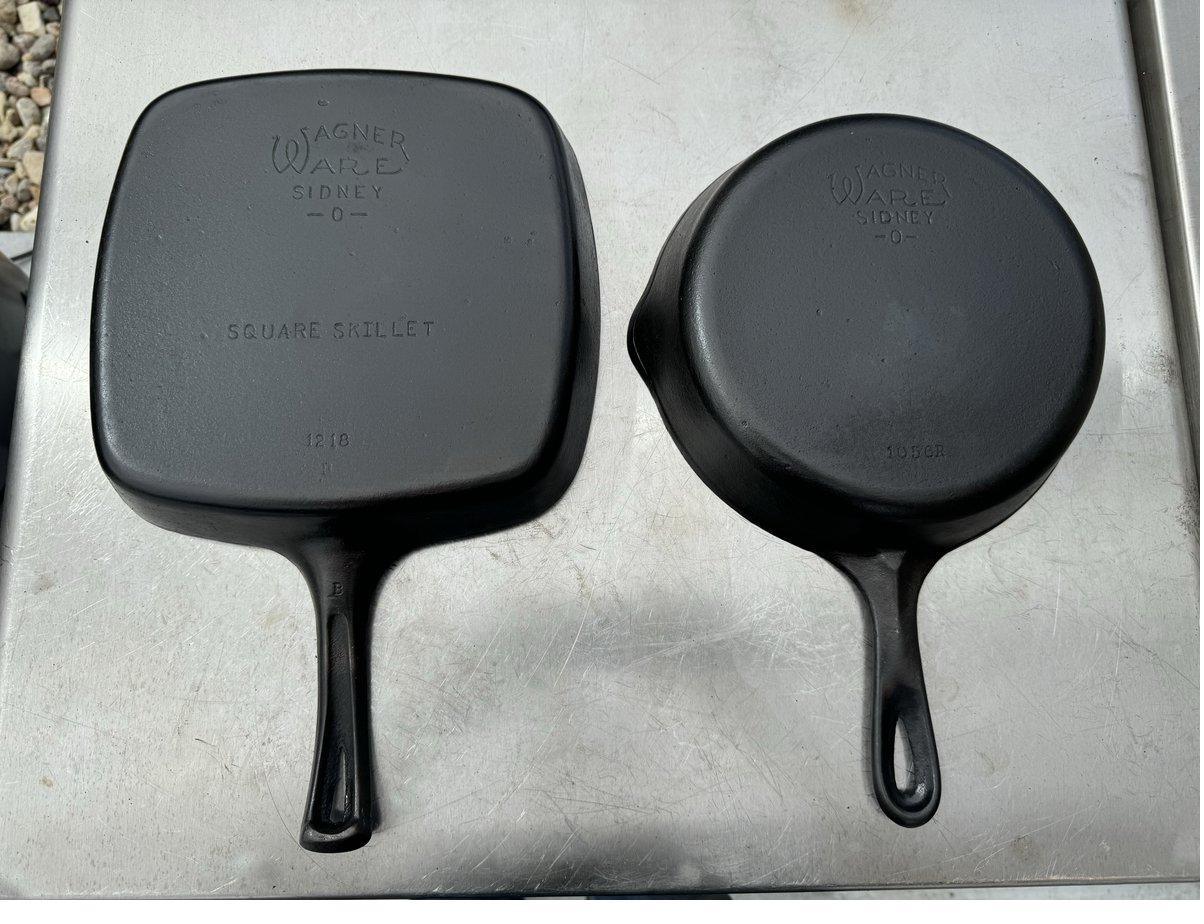
Wagner Ware Sidney pair
Square Skillet 1218 · Round 1056 · Restored
A century of crust off, markings reading like the day they were cast. The square is the rare one — Wagner made rounds by the million and squares by the handful.
RestoredPlattsmouth, Nebraska · U.S.A.
A century of crust comes off in the fire — 1000°, no hotter, and there's a reason for the ceiling. Warp comes out under 20 tons between preheated plates. Then it's blacked by hand with tallow and a terry rag and set over wood smoke. One man, one pan at a time. No coatings, nothing to flake off — just iron that outlived everybody who ever cooked on it.

Off the smoker
Real pans, real photos — nothing rendered. Marked collectibles keep their marks crisp; rough users come back forge-blacked and glass-top flat. And the pile runs deeper than this table shows — box-lot rust to hamburger-logo Martins — so tell me what you're hunting: we may already have it. Inquire, leave a number, and I'll call you back.
Square Skillet 1218 · Round 1056 · Restored
A century of crust off, markings reading like the day they were cast. The square is the rare one — Wagner made rounds by the million and squares by the handful.
Restored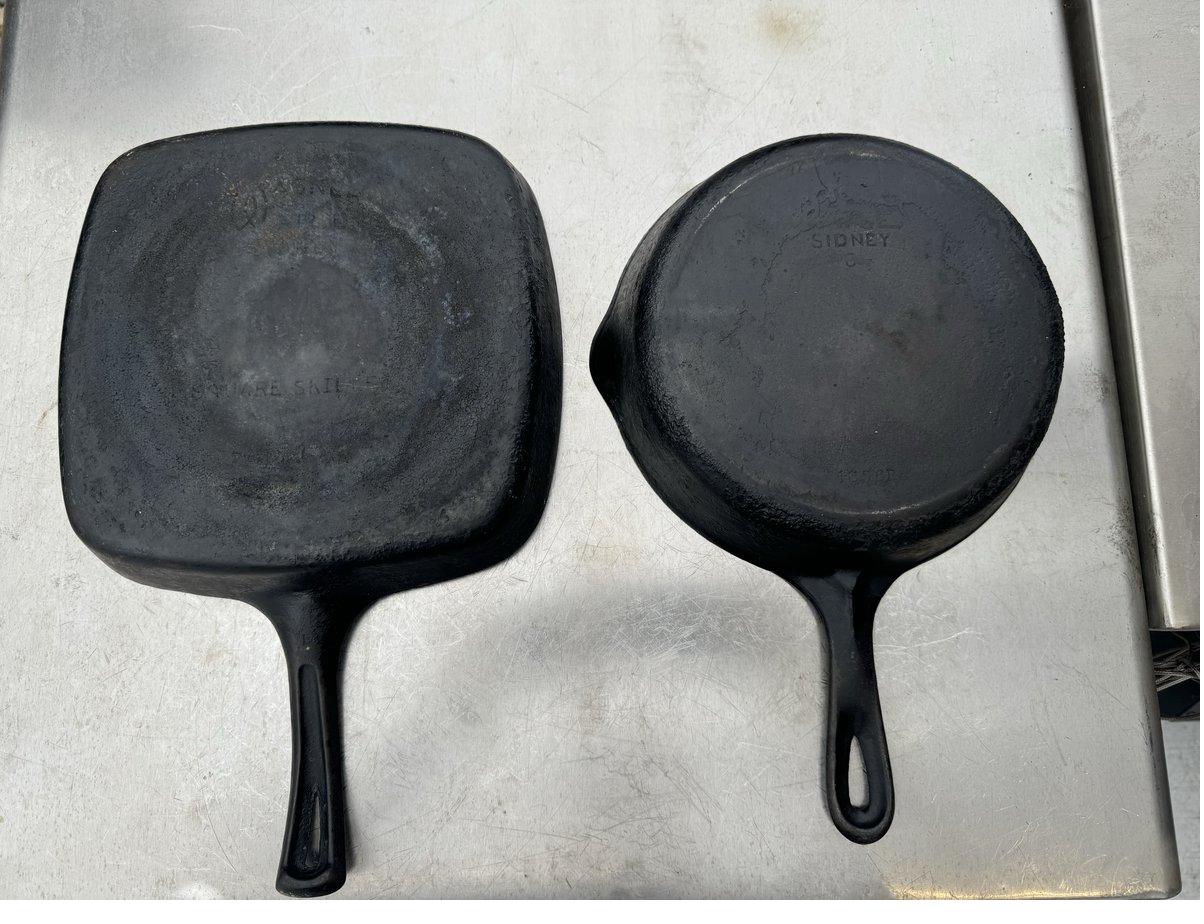
The same two pans · Before
This is what a hundred years of kitchens looks like. Same two Wagners as the photo beside this one — the difference is the whole business.
The before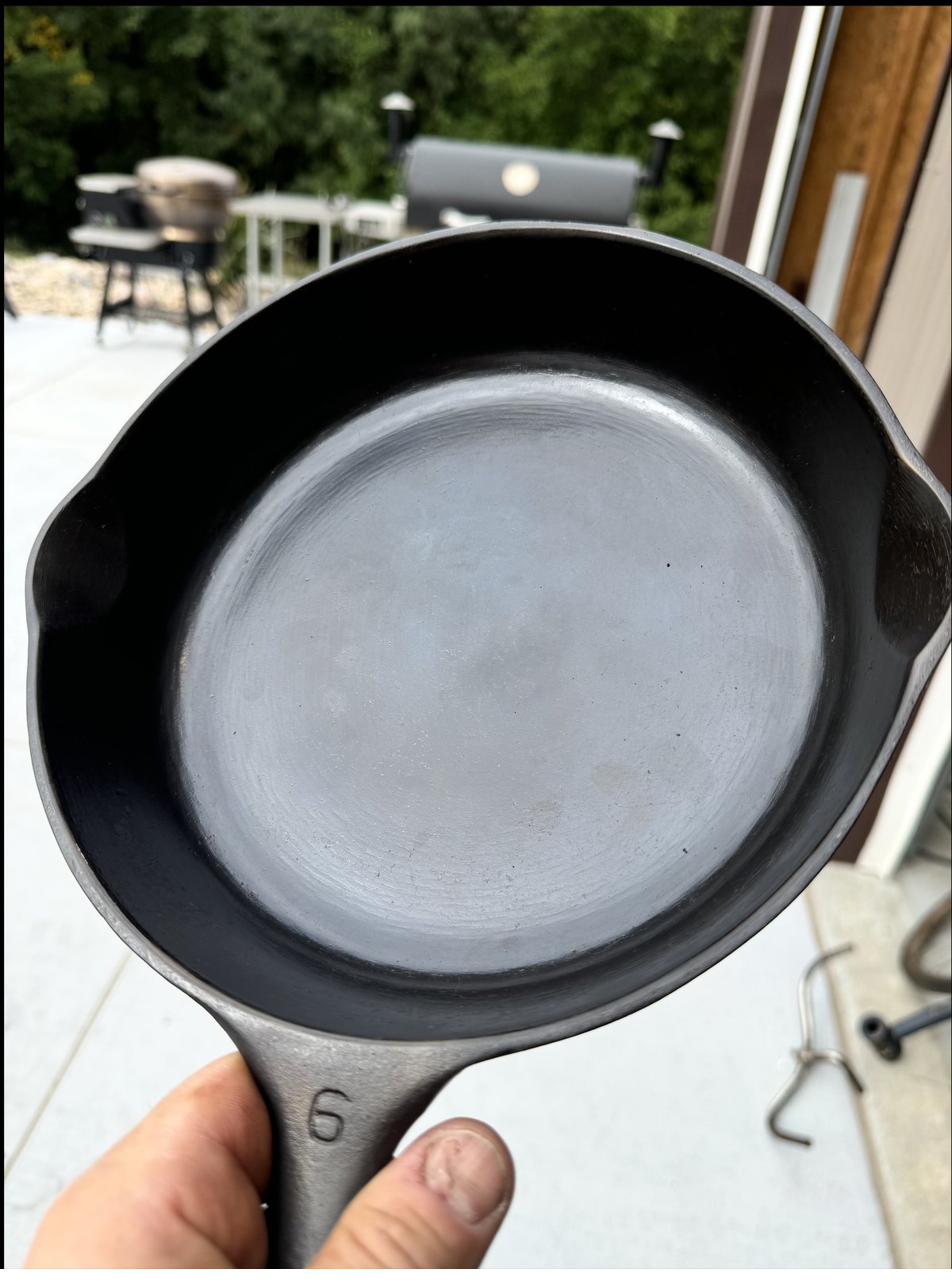
User grade · Forge-blacked · Wood-seasoned
Milled smooth the way they stopped making them. Stripped in the forge, blacked by hand with tallow, seasoned over wood. I cook on these myself.
Ready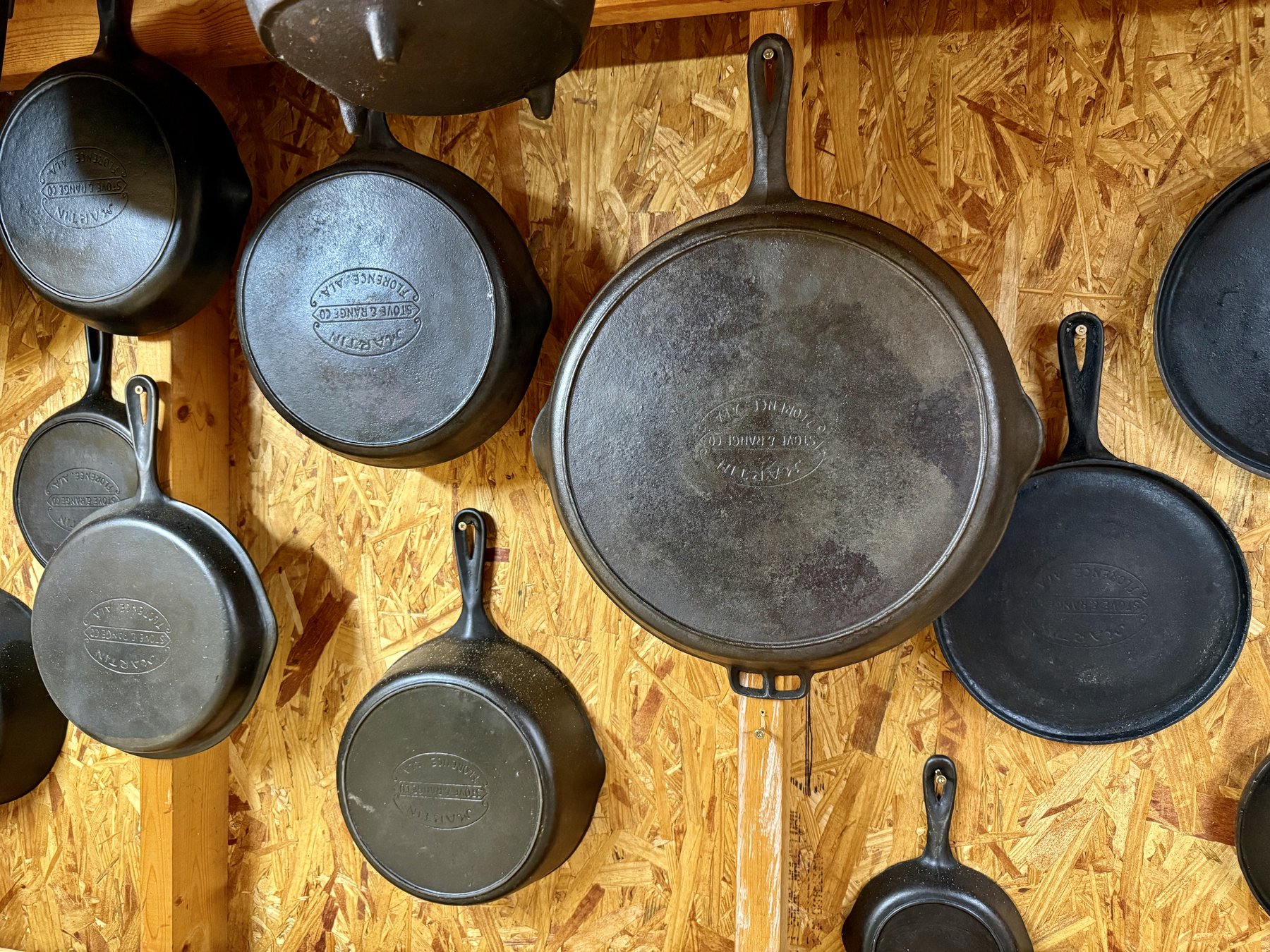
Martin Stove & Range · Hamburger logo · Florence, Alabama
Twenty-eight pieces, No. 3 to No. 14 — skillets, griddles, three Dutch ovens, bean pots with their fancy lids, even the advertising ashtray. The No. 14 with its heat ring is the crown. None of it is priced to move; it's proof the shop knows what it's holding. Serious Martin people: say hello anyway.
The collectionCollectible iron keeps its own maker's marks — a Wagner stays a Wagner. My mark goes on the tag, the process, and the guarantee, never into the casting.
The process
Two tracks, sorted the same way I sort bikes: clean survivors get preserved, rough ones get the fire — and the broken ones get brass.
Marked collectibles — Griswold, Wagner, ERIE and friends — come off cold. Electrolysis and lye at room temperature, no flame, no abrasive. Understand why: fire doesn't hurt cast iron, and anybody who tells you otherwise hasn't thought about where these pans spent their working lives — dropped into the eye of a wood range with flame licking the sides. There's a Martin-built Marco Pride on my patio that still cooks exactly that way. What blurs a mark is what people do after the fire: wire wheels and blast cabinets. So a marked pan gets neither. Gentle is the product.
Rough users get heat, in a specific order. Preheated to 650° first — nothing goes into fire cold, and that one step is most of why a pan doesn't move on you. Then up to 1000° and not a degree past it. The ceiling is deliberate: everything a burn-off has to do is finished by then, and 1000 sits below the temperature where gray iron starts changing on you. Turned by hand the whole way, pulled by eye, checked against a gauge. Warp comes out under 20 tons between preheated plates and gets released before it finishes cooling, so nothing stays locked in the metal. Then blacked by hand — tallow, cotton terry, nothing else — and set over wood smoke. Sits flat on a glass top, guaranteed.
Grandma's skillet, the one in the garage that looks like the "before" photo up top — drop it off or ship it. A skillet rides the mail for cheap, and it comes back with the family name readable again. First thing it gets is the ring test: hung off a finger, tapped, listened to. A pan with a crack in it sounds different, and it goes to the brass line instead of the fire. I'll call you either way before anything happens to it.
Cracked iron doesn't die here. I drill-stop the crack, braze it full with lead-free brass, and polish it back so the seam shows — a gold line through black iron. Longer process, one-of-a-kind result: the break becomes the story, and the piece goes another hundred years. No two cracks alike.
Chasing a pattern — the size 8 your mother had, a square you saw once? Tell me what it is. The pile runs deeper than the table shows, and we may already have what you're looking for. If not, I'll run it down — you get first refusal at a straight price.
No coatings, ever. Nothing to scratch, nothing to flake into the eggs, nothing to replace in three years. Iron and seasoning — the same finish these pans wore a hundred years ago, which is why they're still here.
And nothing here runs through a line. No dip tank, no spray booth, no tumbler, no rack of forty pans hoping for the best. Every one gets rung for cracks before it sees heat, measured with a straightedge going in and coming out, turned by hand, pulled when the color says pull, and blacked with a rag in my hand. The old way isn't nostalgia — it's the only way one man gets it right on a pan somebody's grandmother owned.
The shop
My name is Chris Sills. Down the bench from three hundred vintage bicycles there's a forge, a 20-ton press, and a wood smoker — and the same rule runs both shops: old things that were built to be fixed deserve to be fixed.
Once the forge is hot the line moves — a pan every five minutes, stripped, pressed, blacked and onto the smoker. I cook on these pans — some of them on the Marco Pride out back, a wood-burning range Martin built, eyes pulled and flame on iron the way Florence intended. That's the quality control: if it won't slide an egg in my kitchen, it doesn't get the tag. And the wall behind the bench holds my own Martin hamburger-logo run, No. 3 to No. 14, twenty-eight pieces deep — you don't hand a collector's iron to somebody who isn't one.
The bikes live at Spoke & Sprocket Recyclery — same town, same phone call.
Get in touch
I answer these myself. Tell me what you've got or what you're hunting and we'll go from there.
Click anywhere or press Esc to close